
Issue
Copyright (c) 2026 Osama M. Abu Nahel (Author)

This work is licensed under a Creative Commons Attribution 4.0 International License.
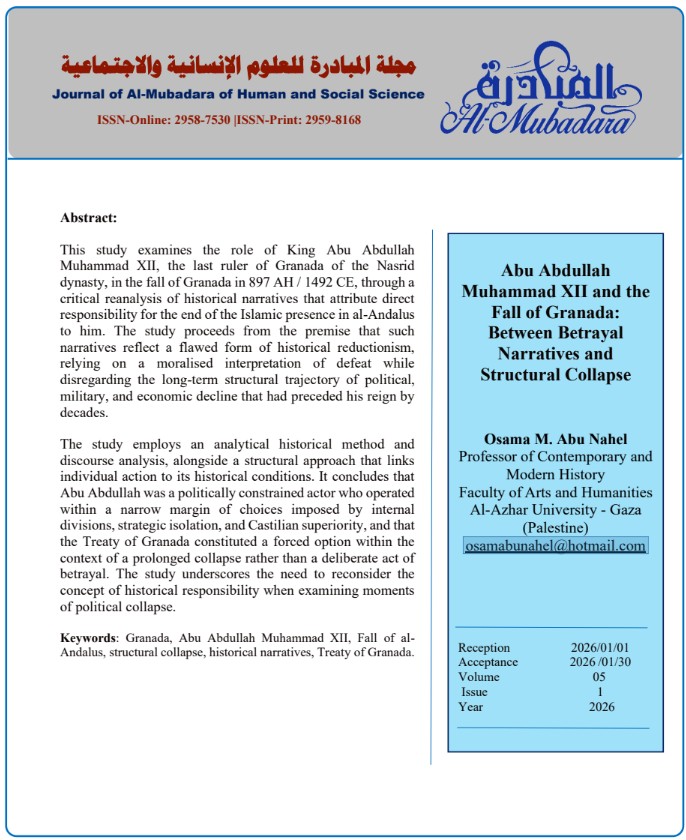
Abu Abdullah Muhammad XII and the Fall of Granada: Between Betrayal Narratives and Structural Collapse

Corresponding Author(s) : Osama M. Abu Nahel
Journal of Al-Mubadara,
Vol. 5 No. 1 (2026)
Abstract
This study examines the role of King Abu Abdullah Muhammad XII, the last ruler of Granada of the Nasrid dynasty, in the fall of Granada in 897 AH / 1492 CE, through a critical reanalysis of historical narratives that attribute direct responsibility for the end of the Islamic presence in al-Andalus to him. The study proceeds from the premise that such narratives reflect a flawed form of historical reductionism, relying on a moralised interpretation of defeat while disregarding the long-term structural trajectory of political, military, and economic decline that had preceded his reign by decades.
The study employs an analytical historical method and discourse analysis, alongside a structural approach that links individual action to its historical conditions. It concludes that Abu Abdullah was a politically constrained actor who operated within a narrow margin of choices imposed by internal divisions, strategic isolation, and Castilian superiority, and that the Treaty of Granada constituted a forced option within the context of a prolonged collapse rather than a deliberate act of betrayal. The study underscores the need to reconsider the concept of historical responsibility when examining moments of political collapse.
Keywords
Download Citation
Endnote/Zotero/Mendeley (RIS)BibTeX
- Abu Nahel, O. M. (2003). “Jān Bardī al-Ghazālī al-Mamlūkī wa al-Dawlah al-ʿUthmāniyyah: Ruʾyah Tārīkhiyyah Jadīdah.” [Jan Bardi al-Ghazali and the Ottoman State: A New Historical Perspective]. An-Najah National University Journal, Vol. 17(1). pp. 55–86. [In Arabic]. https://doi.org/10.35552/0247-017-001-003
- Alawneh, S. Z. (Dec 2019). “Suqūṭ Gharnāṭah 896H / 1492M: Dirāsah Taḥlīliyyah.” [The Fall of Granada, 896 AH / 1492 CE: An Analytical Study]. Revue EL Insan Wa EL Madjal, 5(9), pp. 34–61. [In Arabic]. https://asjp.cerist.dz/en/article/105318?utm_source=copilot.com
- Al-Hajji, A. A. (1981). al-Tārīkh al-Andalusī min al-Fatḥ al-Islāmī Ḥattā Suqūṭ Gharnāṭah 92–897 AH (711–1492 CE). [Andalusian History from the Islamic Conquest to the Fall of Granada, 92–897 AH (711–1492 CE)]. 2nd ed. Damascus & Beirut: Dar al Qalam. [In Arabic].
- Al-Maqari, A. ibn M. (1968). Nafḥ al-Ṭīb min Ghuṣn al-Andalus al-Raṭīb. [The Fragrant Breeze from the Tender Branch of al-Andalus]. Edited by Ihsan Abbas. Vol. 4. Beirut: Dar Sader. [In Arabic].
- Anan, M. A. (1997). Dawlat al-Islām fī al-Andalus: Nihāyat al-Andalus wa Tārīkh al-ʿArab al-Mutanassiṛīn. [The Islamic State in al-Andalus: The End of al-Andalus and the History of Arab Converts to Christianity]. Vol. 4. Cairo: Al-Khanji Library. [In Arabic].
- Anonymous. (2002). Nubdhat al-ʿAṣr fī Akhbār Mulūk Banī Naṣr: Taslīm Gharnāṭah wa Nuzūḥ al-Andalusiyyīn ilā al-Maghrib. [A Glimpse of the Age in the Accounts of the Kings of the Nasrid Dynasty: The Surrender of Granada and the Migration of Andalusians to the Maghreb]. Edited and annotated by al-Farid al-Bustani. 1st ed. Cairo: Religious Culture Library. [In Arabic].
- Attiyat, A. M. (2012). al-Andalus min al-Suqūṭ ilā Maḥākim al-Taftīsh. [Al-Andalus from the Fall to the Inquisition]. 2nd ed. Amman: Amwaj for Printing, Publishing, and Distribution. [In Arabic].
- Baloup, D. (2020). Granada and Castile: A Long Conflict. In Adela Fabregas (Editor). The Nasrid Kingdom of Granada between East and West. Translated by Consuelo Lopez-Morillas. Leiden; London: Brill.
- Bin Rashash, F. S. (2024). “Abū ʿAbd Allāh al-Ṣaghīr, Ākhir Sulṭānāt Gharnāṭah 897 AH / 1492 CE: Khāʾin Am Ḍaḥiyyah? Dirāsah Waṣfiyyah.” [Abu Abdullah al-Saghir, the Last Sultan of Granada (897 AH / 1492 CE): Traitor or Victim? A Descriptive Study]. International Journal of Humanities and Educational Research (IJHER). Vol. 6 (4). pp. 180–191. [In Arabic]. http://dx.doi.org/10.47832/2757-5403.27.9
- Carr, E. H. (1961). What Is History? New York: Vintage.
- Catlos, B. A. (2018). Kingdoms of Faith: A New History of Islamic Spain. New York: Basic Books.
- Elliott, J. H. (2002). Imperial Spain 1469–1716. London: Penguin Books.
- Ibn al-Khatib, L. (1956). Aʿmāl al-Aʿlām fīman Būyiʿa Qabla al-Iḥtilām min Mulūk al-Islām. [The Deeds of Notables: On Those Who Were Given Allegiance before Reaching Maturity among the Kings of Islam]. Edited and annotated by Lévi-Provençal. 2nd ed. Beirut: Dar al-Makshouf. [In Arabic].
- Fairclough, N. (1995). Critical Discourse Analysis: The Critical Study of Language. London; New York: Longman Group Limited.
- Harvey, L. P. (1990). Islamic Spain 1250–1500, Chicago: University of Chicago Press.
- Hattamleh, M. A. (1977). Miḥnat Muslimī al-Andalus ʿAshiyyat Suqūṭ Gharnāṭah wa Baʿdahā. [The Ordeal of Andalusian Muslims on the Eve of the Fall of Granada and Its Aftermath]. 1st ed. Amman: Dar al-Shaʿb Press. [In Arabic].
- Kamen, H. (1998). The Spanish Inquisition: A Historical Revision. New Haven: Yale University Press.
- Kennedy, H. (1996). Muslim Spain and Portugal: A Political History of al-Andalus. London; New York: Routledge.
- Khuris, F. (2025). “Muʿāhadat Gharnāṭah wa al-Khidāʿ al-Qānūnī 897 AH / 1491 CE (Ishkāliyyah Tārīkhiyyah Qānūniyyah). [The Treaty of Granada and Legal Deception, 897 AH / 1491 CE (A Historical–Legal Problematization)]. Journal of Scientific Development for Studies and Research, Vol. 6(23). pp. 122–137. [In Arabic]. https://doi.org/10.61212/jsd/366
- Ladero Quesada, M. Á. (2000). La Granada de los Reyes Católicos. Madrid: Alianza Editorial.
- Lane-Poole, S. (1887). The Moors in Spain. London: T. Fisher Unwin.
- Lapidus, I. M. (2014), A History of Islamic Societies. Cambridge; New York: Cambridge University Press.
- Levi-Provençal É. (1953). Histoire de l’Espagne Musulmane: le siècle du califat de Cordoue. Paris: Éditions G. - P. Maisonneuve et Cie.
- Lévi-Strauss, C. (1963). Structural Anthropology. New York: Basic Books.
- Meyerson, M. D. (2004). A Jewish Renaissance in Fifteenth-Century Spain. Princeton: Princeton University Press.
- O’Callaghan, J. F. (1975). A History of Medieval Spain. Ithaca: Cornell University Press.
- O’Callaghan, J. F. (2003). Reconquest and Crusade in Medieval Spain. Philadelphia: University of Pennsylvania Press.
- Pagden, A. (1995). Lords of All the World: Ideologies of Empire in Spain, Britain, and France. New Haven: Yale University Press.
- Ruiz, T. F. (2007). Spain’s Centuries of Crisis: 1300–1474. Malden, MA; Oxford: Blackwell.
- Skocpol, T. (1979). States and Social Revolutions: A Comparative Analysis of France, Russia, and China. Cambridge; New York: Cambridge University Press.
- Tilly, C. (1978). From Mobilization to Revolution. New York: Random House.
- Tilly, C. (1990). Coercion, Capital, and European States, AD 990–1990.
- Cambridge, MA; Oxford, UK: Basil Blackwell Inc.
- van Dijk, T. A. (1998). Ideology: A Multidisciplinary Approach. London: Sage Publications.
References
Abu Nahel, O. M. (2003). “Jān Bardī al-Ghazālī al-Mamlūkī wa al-Dawlah al-ʿUthmāniyyah: Ruʾyah Tārīkhiyyah Jadīdah.” [Jan Bardi al-Ghazali and the Ottoman State: A New Historical Perspective]. An-Najah National University Journal, Vol. 17(1). pp. 55–86. [In Arabic]. https://doi.org/10.35552/0247-017-001-003
Alawneh, S. Z. (Dec 2019). “Suqūṭ Gharnāṭah 896H / 1492M: Dirāsah Taḥlīliyyah.” [The Fall of Granada, 896 AH / 1492 CE: An Analytical Study]. Revue EL Insan Wa EL Madjal, 5(9), pp. 34–61. [In Arabic]. https://asjp.cerist.dz/en/article/105318?utm_source=copilot.com
Al-Hajji, A. A. (1981). al-Tārīkh al-Andalusī min al-Fatḥ al-Islāmī Ḥattā Suqūṭ Gharnāṭah 92–897 AH (711–1492 CE). [Andalusian History from the Islamic Conquest to the Fall of Granada, 92–897 AH (711–1492 CE)]. 2nd ed. Damascus & Beirut: Dar al Qalam. [In Arabic].
Al-Maqari, A. ibn M. (1968). Nafḥ al-Ṭīb min Ghuṣn al-Andalus al-Raṭīb. [The Fragrant Breeze from the Tender Branch of al-Andalus]. Edited by Ihsan Abbas. Vol. 4. Beirut: Dar Sader. [In Arabic].
Anan, M. A. (1997). Dawlat al-Islām fī al-Andalus: Nihāyat al-Andalus wa Tārīkh al-ʿArab al-Mutanassiṛīn. [The Islamic State in al-Andalus: The End of al-Andalus and the History of Arab Converts to Christianity]. Vol. 4. Cairo: Al-Khanji Library. [In Arabic].
Anonymous. (2002). Nubdhat al-ʿAṣr fī Akhbār Mulūk Banī Naṣr: Taslīm Gharnāṭah wa Nuzūḥ al-Andalusiyyīn ilā al-Maghrib. [A Glimpse of the Age in the Accounts of the Kings of the Nasrid Dynasty: The Surrender of Granada and the Migration of Andalusians to the Maghreb]. Edited and annotated by al-Farid al-Bustani. 1st ed. Cairo: Religious Culture Library. [In Arabic].
Attiyat, A. M. (2012). al-Andalus min al-Suqūṭ ilā Maḥākim al-Taftīsh. [Al-Andalus from the Fall to the Inquisition]. 2nd ed. Amman: Amwaj for Printing, Publishing, and Distribution. [In Arabic].
Baloup, D. (2020). Granada and Castile: A Long Conflict. In Adela Fabregas (Editor). The Nasrid Kingdom of Granada between East and West. Translated by Consuelo Lopez-Morillas. Leiden; London: Brill.
Bin Rashash, F. S. (2024). “Abū ʿAbd Allāh al-Ṣaghīr, Ākhir Sulṭānāt Gharnāṭah 897 AH / 1492 CE: Khāʾin Am Ḍaḥiyyah? Dirāsah Waṣfiyyah.” [Abu Abdullah al-Saghir, the Last Sultan of Granada (897 AH / 1492 CE): Traitor or Victim? A Descriptive Study]. International Journal of Humanities and Educational Research (IJHER). Vol. 6 (4). pp. 180–191. [In Arabic]. http://dx.doi.org/10.47832/2757-5403.27.9
Carr, E. H. (1961). What Is History? New York: Vintage.
Catlos, B. A. (2018). Kingdoms of Faith: A New History of Islamic Spain. New York: Basic Books.
Elliott, J. H. (2002). Imperial Spain 1469–1716. London: Penguin Books.
Ibn al-Khatib, L. (1956). Aʿmāl al-Aʿlām fīman Būyiʿa Qabla al-Iḥtilām min Mulūk al-Islām. [The Deeds of Notables: On Those Who Were Given Allegiance before Reaching Maturity among the Kings of Islam]. Edited and annotated by Lévi-Provençal. 2nd ed. Beirut: Dar al-Makshouf. [In Arabic].
Fairclough, N. (1995). Critical Discourse Analysis: The Critical Study of Language. London; New York: Longman Group Limited.
Harvey, L. P. (1990). Islamic Spain 1250–1500, Chicago: University of Chicago Press.
Hattamleh, M. A. (1977). Miḥnat Muslimī al-Andalus ʿAshiyyat Suqūṭ Gharnāṭah wa Baʿdahā. [The Ordeal of Andalusian Muslims on the Eve of the Fall of Granada and Its Aftermath]. 1st ed. Amman: Dar al-Shaʿb Press. [In Arabic].
Kamen, H. (1998). The Spanish Inquisition: A Historical Revision. New Haven: Yale University Press.
Kennedy, H. (1996). Muslim Spain and Portugal: A Political History of al-Andalus. London; New York: Routledge.
Khuris, F. (2025). “Muʿāhadat Gharnāṭah wa al-Khidāʿ al-Qānūnī 897 AH / 1491 CE (Ishkāliyyah Tārīkhiyyah Qānūniyyah). [The Treaty of Granada and Legal Deception, 897 AH / 1491 CE (A Historical–Legal Problematization)]. Journal of Scientific Development for Studies and Research, Vol. 6(23). pp. 122–137. [In Arabic]. https://doi.org/10.61212/jsd/366
Ladero Quesada, M. Á. (2000). La Granada de los Reyes Católicos. Madrid: Alianza Editorial.
Lane-Poole, S. (1887). The Moors in Spain. London: T. Fisher Unwin.
Lapidus, I. M. (2014), A History of Islamic Societies. Cambridge; New York: Cambridge University Press.
Levi-Provençal É. (1953). Histoire de l’Espagne Musulmane: le siècle du califat de Cordoue. Paris: Éditions G. - P. Maisonneuve et Cie.
Lévi-Strauss, C. (1963). Structural Anthropology. New York: Basic Books.
Meyerson, M. D. (2004). A Jewish Renaissance in Fifteenth-Century Spain. Princeton: Princeton University Press.
O’Callaghan, J. F. (1975). A History of Medieval Spain. Ithaca: Cornell University Press.
O’Callaghan, J. F. (2003). Reconquest and Crusade in Medieval Spain. Philadelphia: University of Pennsylvania Press.
Pagden, A. (1995). Lords of All the World: Ideologies of Empire in Spain, Britain, and France. New Haven: Yale University Press.
Ruiz, T. F. (2007). Spain’s Centuries of Crisis: 1300–1474. Malden, MA; Oxford: Blackwell.
Skocpol, T. (1979). States and Social Revolutions: A Comparative Analysis of France, Russia, and China. Cambridge; New York: Cambridge University Press.
Tilly, C. (1978). From Mobilization to Revolution. New York: Random House.
Tilly, C. (1990). Coercion, Capital, and European States, AD 990–1990.
Cambridge, MA; Oxford, UK: Basil Blackwell Inc.
van Dijk, T. A. (1998). Ideology: A Multidisciplinary Approach. London: Sage Publications.